WhatsAppnow
Marta Kowalski
Hi! We are just landing now, where do we find the key?
Port Kennedy, WA · Metropolitan suburb
Port Kennedy is a metropolitan suburb. A useful direct-booking page should turn that setting into verified decisions about the property, arrival and guest fit, while every productive OTA listing remains live beside the owned channel.
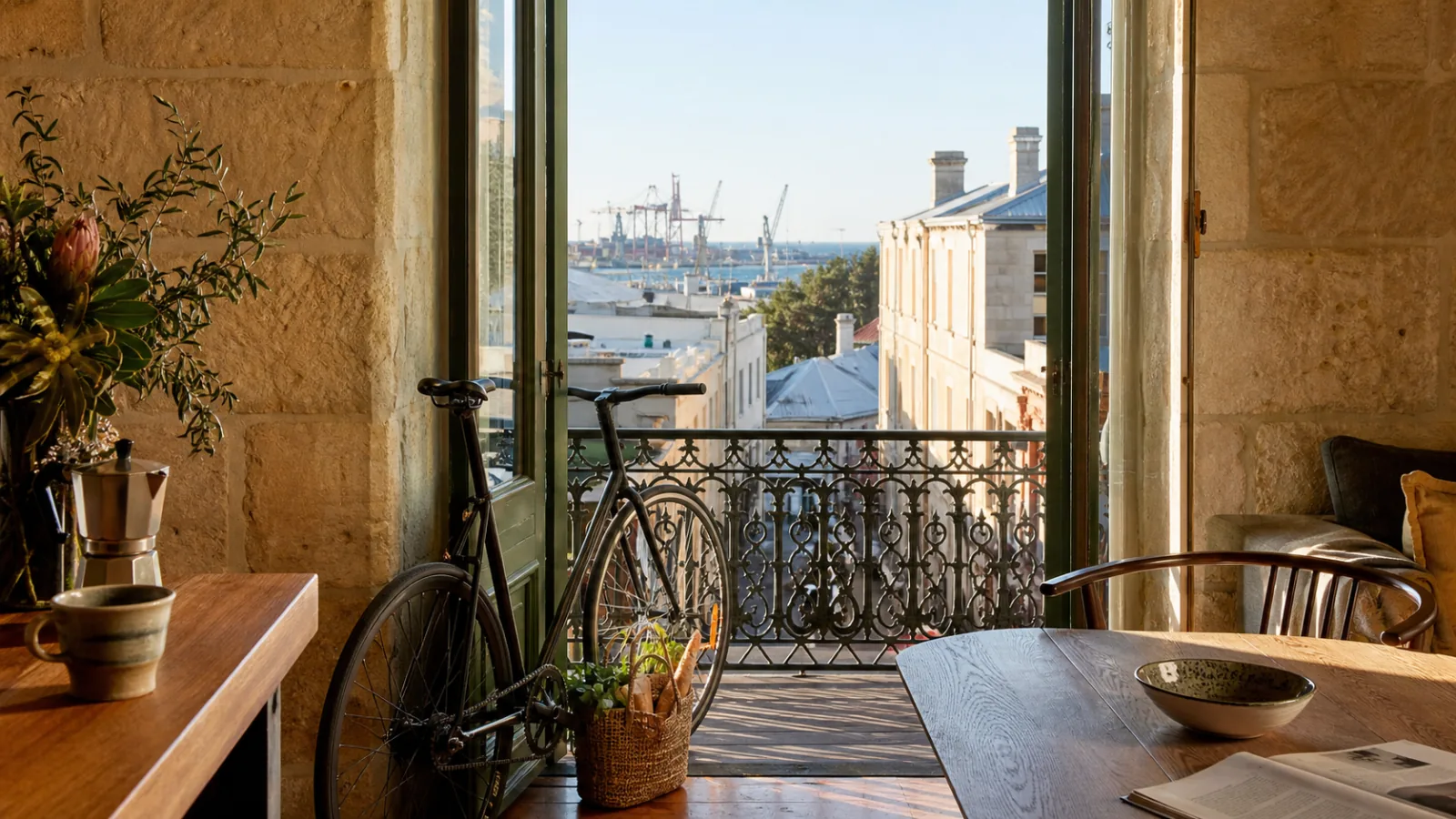
Regional image of Fremantle. Not the property.
The evidence block below links the 2021 source that counted 13,477 residents and recorded 4,787 private dwellings, with 292 unoccupied on Census night. No dwelling category in this table should be converted into a claim about active rentals without separate, current proof. Census evidence does not measure visitor or booking demand.
Fremantle is the closest sizeable market, roughly 35 kilometres to the south. The figure gives orientation without establishing drive time, service coverage or administrative inclusion. The nearby guides for Warnbro and Secret Harbour give guests two useful comparison points without turning the page into an indiscriminate link list.
Almost everything in Port Kennedy is a standalone house: 4,207 of 4,488 occupied private dwellings, or 93.7%.
Housing in Port Kennedy runs large: four-bedroom homes are the single commonest size at 71.6% of occupied private dwellings, and 93.9% have three bedrooms or more. The 2021 count recorded 16 one-bedroom, 181 two-bedroom, 679 three-bedroom and 3,215 four-bedroom dwellings, plus 318 with five bedrooms or more. That puts Port Kennedy close to the Fremantle area median of 88.2% for three-bedroom-plus stock.
Port Kennedy is a two-car locality: 66.9% of occupied dwellings kept two or more motor vehicles in 2021. The split was 1,349 dwellings with one vehicle, 1,888 with two and 1,065 with three or more. Only 2.6% recorded no motor vehicle.
67.3% of work journeys from Port Kennedy were made by car on Census day. 1.2% walked or cycled. 5.6% worked from home, which is a fair proxy for whether the internet here is good enough to sell a stay on.
The commonest household in Port Kennedy is two-person, at 32.7% of households. 16.8% live alone and 31.7% of households hold four people or more. Across 3,735 families, 46.3% were couples with children, 33.7% couples without and 18.7% one-parent families.
The median age in Port Kennedy was 36 at the 2021 Census, younger than the Fremantle area median of 41. Households averaged 2.8 people and 0.7 persons per bedroom. Median rent was $350 a week, about level with the $355 median across the Fremantle localities DirectStay covers. Median mortgage repayments were $1,700 a month. Median household income ran to $1,921 a week, against $755 for an individual.
Tenure in Port Kennedy split 21.5% owned outright, 51.9% mortgaged and 22.4% rented in 2021. That is 1,006 rented dwellings in the locality count.
Every figure above describes the resident population of Port Kennedy at the 2021 Census. None of it describes visitors, nightly rates, occupancy or short-stay supply, and it must not be presented as if it did. Its use is to set expectations a host can then confirm from the property itself: the real bedroom count and bed layout, how many vehicles the space genuinely takes and whether that space is on-title or on-street, the actual route to the door, and the house rules a street of this kind will expect around noise and turnover.
Likely trip purposes here include regional touring and stopovers, family or community visits and practical multi-night stays. The host's enquiry log can validate, narrow or replace these provisional categories.
Sources: ABS 2021 Census DataPacks locality evidence (SAL51260) and ABS 2021 Census DataPacks, Suburbs and Localities tables G02 medians and averages, G29 family composition, G34 motor vehicles, G35 household composition, G36 dwelling structure, G37 tenure, G41 bedrooms and G62 travel to work and ABS ASGS Edition 3 Suburbs and Localities geography. Census figures provide locality context only and do not measure short-stay demand.
Document street-level access, parking, public-transport options and the property's relationship to likely city destinations with current media and checked operational detail.
Explain the route from the guest's likely arrival point through parking, unloading and entry without guaranteeing fixed journey times.
Keep current listings active, synchronise availability and give repeat or referred guests a credible direct path.
The guest CRM
Keep arrival questions, booking changes and follow-up messages for every stay in one thread, across the channels guests already use.
The Direct Stay guest inbox. Four conversations that arrived on WhatsApp, Telegram, iMessage and email sit in one list, and Marta Kowalski's WhatsApp thread is open beside it with a reply written in the composer.
Start with what you need now. Add more properties and tools when you are ready.
For 1–2 properties. Film, direct-booking site, Google profile and the core booking setup.
Start with LaunchFor 3–8 properties. Add multi-property discovery, guest messaging and ongoing visibility.
Talk about ScaleFor large property groups. Manage direct bookings across several regions in one place.
See portfolio plansLocal decisions a useful booking page should make easier.
Use current photographs, the exact property type, bed and bathroom configuration, maximum occupancy, access limits, parking, included amenities and maintained booking terms. Add nearby places only after checking their relevance and the route from the real address. The reused Fremantle image is editorial context and must never be described as the property or as a verified view of the locality.
Describe the verified route and the guest's practical reason for travelling between the property and a relevant destination. That 35-kilometre south figure is measured in a straight line. It is not a drive-time promise, and it does not mean Port Kennedy sits inside the larger market.
Begin with regional touring and stopovers, family or community visits and practical multi-night stays because those purposes are carried in the prepared locality record. Confirm them using genuine enquiries and booking history, then publish the property features, arrival information and policies each group needs. Do not turn a plausible use case into a statement about demand volume.
No. Keep productive OTA listings live while building the owned route. Synchronise calendars and commercial rules, honour the terms of existing bookings, use consent-based follow-up, and let referred or returning guests choose the direct site when appropriate. The objective is a stronger owned relationship without sacrificing distribution that already works.
Explore this local area.
View the Fremantle guideKeep every productive OTA listing live.
Hey. What are you trying to sort out?