WhatsAppnow
Marta Kowalski
Hi! We are just landing now, where do we find the key?
Fannie Bay, NT
Fannie Bay needs a booking page that answers whether the address suits the purpose of the trip. Combine official locality context with property facts the host can prove, precise arrival instructions and a maintained booking path. Current OTA listings can stay live while the owned channel earns trust and gives returning guests a memorable route back.
Regional image of Darwin. Not the property.
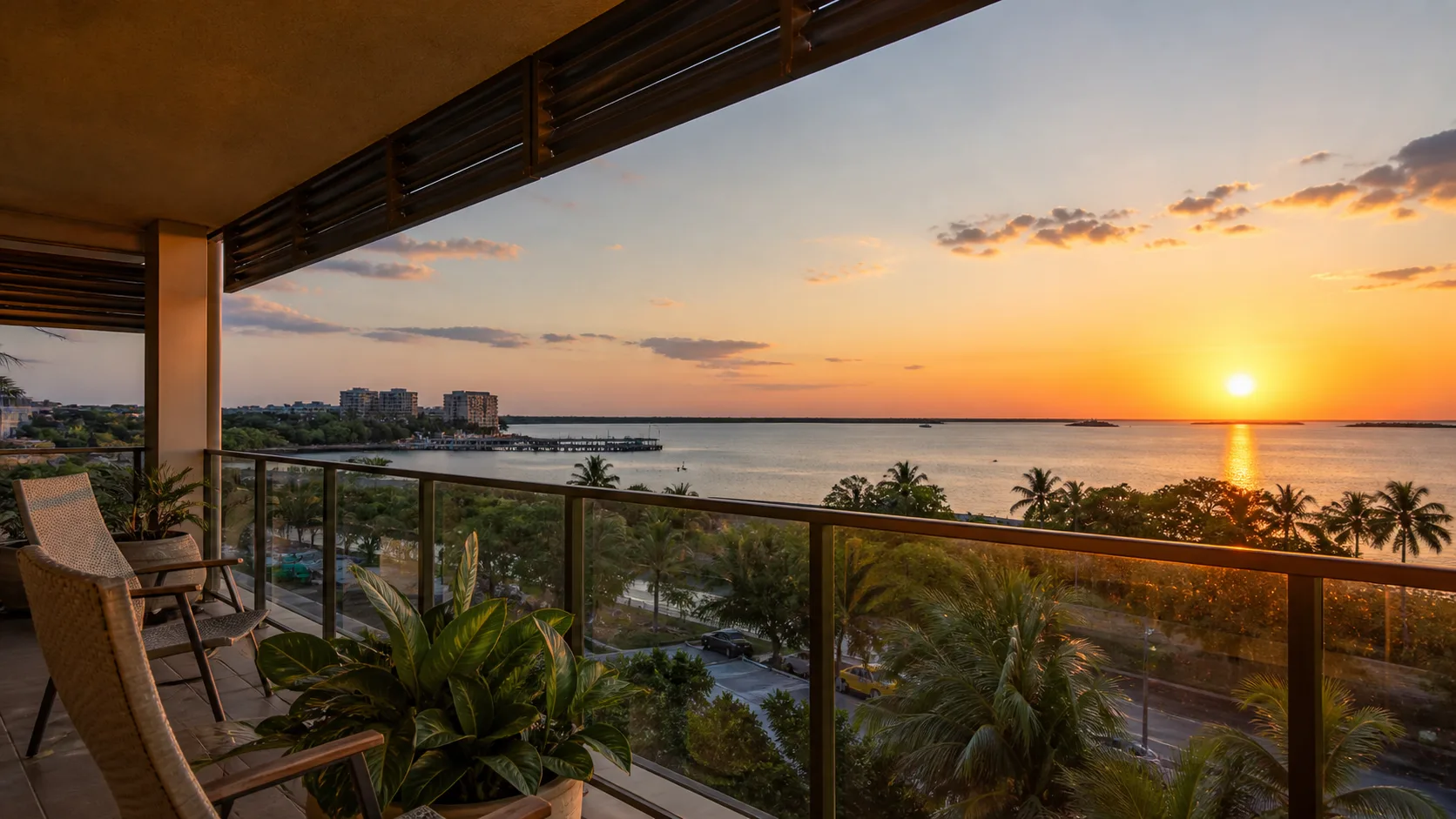
Fannie Bay sits north of Darwin, about 4 km away in a straight line. The parent relationship determines the approved image and wider guide link; it must not be rewritten as a driving distance or a claim that Fannie Bay lies inside Darwin. The map query targets Fannie Bay, Northern Territory, so a guest sees the correct locality rather than the parent image market.
Official 2021 Census evidence records 2,875 residents and 1,260 private dwellings for Fannie Bay. It also records 106 dwellings unoccupied on Census night, equal to 8.4%. The record is a populated locality retained through the resident-population threshold. None of those measures establishes tourism, bookings, occupancy performance, accommodation supply or short-stay demand.
Five retained localities provide a practical map check around Fannie Bay: Parap (1.2 km straight-line), Ludmilla (1.6 km straight-line), Bayview (2.4 km straight-line), Stuart Park (2.5 km straight-line), Coconut Grove (3.3 km straight-line). These are geographic reference points calculated from the official locality coordinates, not claims about road distance, travel time, shared attractions or a single accommodation market. Guests should receive address-specific directions and current operator links after the host verifies the route. The two closest retained references are Parap to the south and Ludmilla to the north-east; their clean internal guides appear below.
The source profile classifies Fannie Bay as a metropolitan suburb. That makes regional touring and stopovers, family or community visits, practical multi-night stays sensible planning prompts, not measured demand segments. A useful page should help those guests test fit through the property's verified capacity, sleep setup, kitchen and laundry facilities, work surface, cooling, parking, accessibility and stay rules. In Fannie Bay, property proof should be published in this order: capacity, bathrooms, key collection, luggage handling, parking and house rules. Each statement needs a host-supplied fact, current photograph, booking-engine setting or checked arrival instruction behind it. If proof is absent, the page should ask for it rather than imply a feature, view, walking time, transport frequency or local service.
Arrival clarity for Fannie Bay begins at the real address. State whether a guest approaches by sealed road, shared driveway, lobby, stairs, lift or external path; explain where a vehicle may legally stop; identify the key or lockbox sequence; and tell late arrivals when detailed directions are sent. Verify every route and access claim before publication, because locality coordinates and the Darwin reference cannot answer property-level questions.
Direct-booking positioning for Fannie Bay should stay commercially calm. Keep active marketplace listings, rates and availability aligned while the host builds an owned website, consent-based follow-up and a recognisable local page. Explain inclusions, payment timing, cancellation terms and support contacts consistently. The point is to add a credible booking choice and retain the guest relationship, not to criticise platforms or promise savings, ranking, occupancy or revenue.
Of 1,155 occupied private dwellings in Fannie Bay, 35.1% are separate houses, 47% townhouses and 17.7% flats or apartments.
The commonest home in Fannie Bay is three-bedroom at 36.1% of occupied private dwellings, with 59.2% at three bedrooms or more. The 2021 count recorded 84 one-bedroom, 378 two-bedroom, 417 three-bedroom and 178 four-bedroom dwellings, plus 89 with five bedrooms or more. That puts Fannie Bay below the Darwin area median of 72.9% for three-bedroom-plus stock.
In 2021, 52.5% of occupied dwellings in Fannie Bay kept two or more motor vehicles. The split was 478 dwellings with one vehicle, 413 with two and 185 with three or more. Only 5.4% recorded no motor vehicle.
73.1% of work journeys from Fannie Bay were made by car on Census day. 4.8% walked or cycled. 6.1% worked from home, which is a fair proxy for whether the internet here is good enough to sell a stay on.
The commonest household in Fannie Bay is two-person, at 35.2% of households. Lone-person households are a large share at 30.8%, with 18.5% of households at four people or more. Across 736 families, 38.7% were couples with children, 47.7% couples without and 12.5% one-parent families.
The median age in Fannie Bay was 39 at the 2021 Census, older than the Darwin area median of 34. Households averaged 2.3 people and 0.8 persons per bedroom. Median rent was $390 a week, about level with the $360 median across the Darwin localities DirectStay covers. Median mortgage repayments were $2,167 a month. Median household income ran to $2,213 a week, against $1,322 for an individual.
Fannie Bay has a substantial rental base, with 48.7% of occupied private dwellings rented in 2021, 22.3% mortgaged and 23.4% owned outright. That is 562 rented dwellings in the locality count.
Every figure above describes the resident population of Fannie Bay at the 2021 Census. None of it describes visitors, nightly rates, occupancy or short-stay supply, and it must not be presented as if it did. Its use is to set expectations a host can then confirm from the property itself: the real bedroom count and bed layout, how many vehicles the space genuinely takes and whether that space is on-title or on-street, the actual route to the door, and the house rules a street of this kind will expect around noise and turnover.
Sources: ABS 2021 Census DataPacks (SAL70097) and ABS ASGS Edition 3 locality framework and ABS 2021 Census DataPacks, Suburbs and Localities tables G02 medians and averages, G29 family composition, G34 motor vehicles, G35 household composition, G36 dwelling structure, G37 tenure, G41 bedrooms and G62 travel to work. Census figures provide locality context only and do not measure short-stay demand.
Use the official locality, the Darwin editorial relationship and nearby references such as Parap without converting straight-line calculations into road promises.
Show the actual property type, capacity, sleep plan, access, parking, climate control, facilities and rules with current host-verified evidence.
Keep inventory, rates, payments and cancellation information consistent across the owned site and every listing that remains live.
The guest CRM
Keep arrival questions, booking changes and follow-up messages for every stay in one thread, across the channels guests already use.
The Direct Stay guest inbox. Four conversations that arrived on WhatsApp, Telegram, iMessage and email sit in one list, and Marta Kowalski's WhatsApp thread is open beside it with a reply written in the composer.
Start with what you need now. Add more properties and tools when you are ready.
For 1–2 properties. Film, direct-booking site, Google profile and the core booking setup.
Start with LaunchFor 3–8 properties. Add multi-property discovery, guest messaging and ongoing visibility.
Talk about ScaleFor large property groups. Manage direct bookings across several regions in one place.
See portfolio plansLocal decisions a useful booking page should make easier.
Use it only to describe the official locality's resident and dwelling context. For Fannie Bay, Census-night occupancy cannot prove tourism, visitor demand, short-stay supply or booking performance. Property analytics, enquiry records and verified guest feedback are separate evidence and should be labelled separately.
The five closest retained localities sharing the Darwin parent are Parap, Ludmilla, Bayview, Stuart Park, Coconut Grove. Use them to orient the map and cross-check place identity, not to promise a route, travel time, attraction set or interchangeable guest experience.
Confirm the address, property type, legal capacity, bed and bathroom setup, parking, accessibility, cooling, facilities, check-in sequence, payment timing, availability, cancellation terms and contact process. For Fannie Bay, current images and address-specific arrival instructions are stronger proof than generic amenity language.
Explore this local area.
View the Darwin guideKeep every current Fannie Bay listing live.
Hey. What are you trying to sort out?